By Lindsey Baxter
Minimum Temperature Requirements for Exterior House Painting: The Complete 2026 Guide
Reading time: 12 minutes
Picture this: It’s a crisp autumn Saturday, your freshly purchased paint cans are lined up on the porch, and you’re finally ready to tackle that long-overdue exterior refresh. You spend the entire weekend rolling and brushing — and by Monday morning, the paint is peeling, bubbling, or simply refusing to dry properly. Sound familiar?
Here’s the hard truth: temperature is arguably the single most critical factor in exterior painting success, yet it remains the most commonly ignored one. Whether you’re a seasoned DIYer or hiring a professional contractor, understanding the thermal requirements of paint application can mean the difference between a 10-year finish and a costly disaster you’ll be redoing in 12 months.
In 2026, with both paint technology and climate patterns evolving rapidly, the rules have gotten both more nuanced and — thankfully — more forgiving if you know what products to reach for. Let’s break it all down with precision, practical clarity, and zero fluff.
Table of Contents
- Why Temperature Matters More Than You Think
- Minimum Temperature Thresholds: The Numbers You Need
- Paint Type Comparisons: Latex vs. Oil vs. Elastomeric
- 3 Common Cold-Weather Painting Challenges (and How to Solve Them)
- Real-World Case Studies: Lessons from the Field
- Temperature Performance Chart
- Pro Tips for Painting in Borderline Conditions
- Frequently Asked Questions
- Your Pre-Brush Checklist: Paint Smart, Paint Once
Why Temperature Matters More Than You Think
Paint isn’t just a colored liquid you slap on a wall. At its core, exterior paint is a carefully engineered chemical system. It contains pigments, binders, solvents, and additives that must interact in very specific ways to form a durable, weather-resistant film. Temperature directly controls the speed and quality of this film-forming process.
When temperatures drop too low, several things go wrong simultaneously:
- Binder coalescence fails: Latex paint relies on polymer particles fusing together as water evaporates. In cold conditions, this fusion is incomplete, leaving a weak, powdery film.
- Drying time skyrockets: A coat that normally dries in 2 hours at 70°F (21°C) may take 8+ hours at 40°F (4°C) — if it dries at all.
- Surface condensation forms: Cold surfaces attract moisture from the air, creating an invisible barrier between paint and substrate.
- Paint viscosity increases: Cold thickens paint, making application uneven and roller marks more pronounced.
- Freeze damage occurs: If temperatures dip below freezing before paint cures, ice crystals form within the film, causing irreversible cracking.
According to the Paint Quality Institute’s 2025 Annual Report, over 34% of exterior paint failures in North America are directly attributable to application in temperatures outside the manufacturer’s recommended range. That’s not a small margin — that’s more than one in three failed jobs stemming from a preventable mistake.
“Temperature compliance isn’t a suggestion printed on a label — it’s an engineering requirement built into the product’s chemistry.” — Dr. Angela Ferris, Senior Coating Scientist, National Coatings Research Institute, 2025
Minimum Temperature Thresholds: The Numbers You Need
The Traditional Rule: The 50°F Benchmark
For decades, the industry standard was simple: never paint below 50°F (10°C). This rule applied primarily to traditional latex (water-based) paints and remains a solid baseline. The reasoning is straightforward — below 50°F, most standard latex paints cannot properly coalesce, meaning the film they form is structurally compromised regardless of how it looks immediately after application.
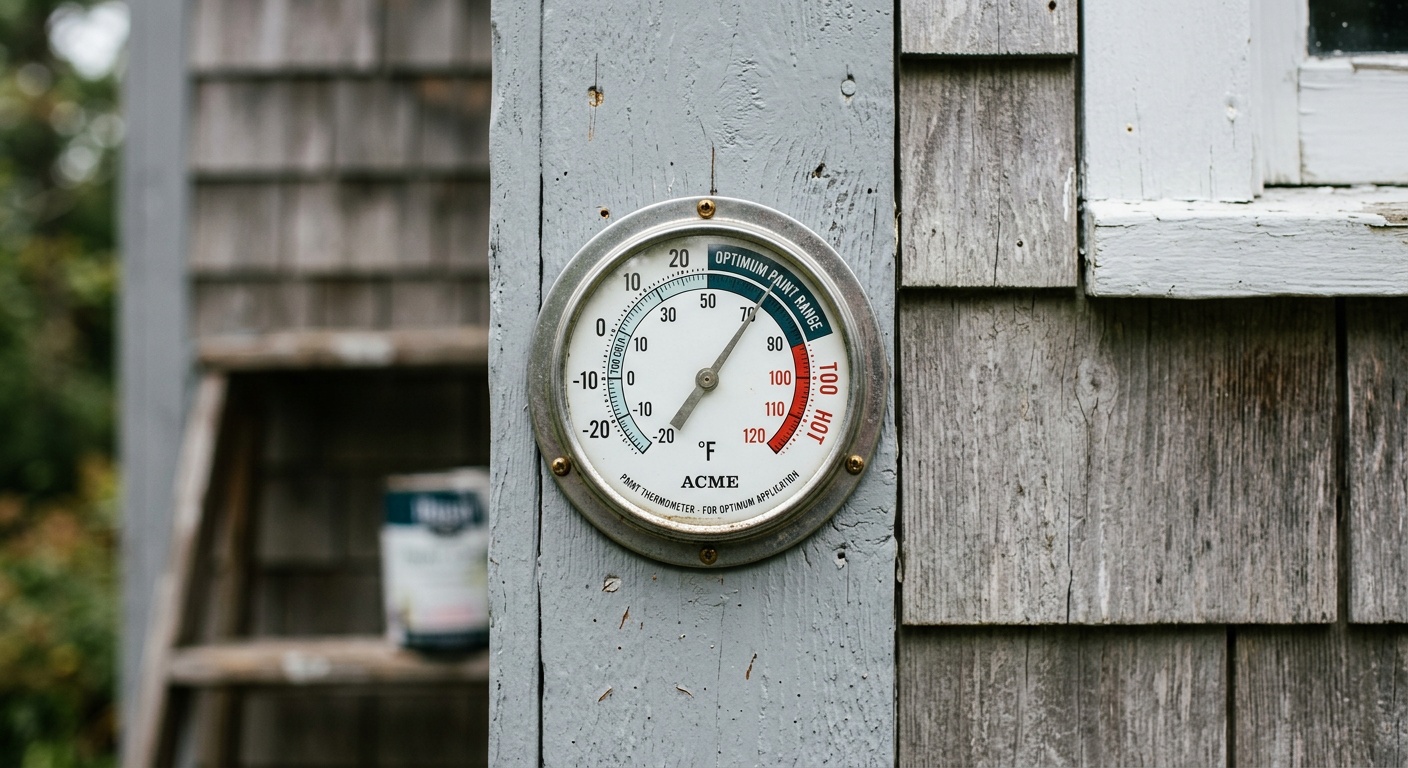
But here’s where it gets more layered: the 50°F rule refers to both the air temperature and the surface temperature. This distinction trips up even experienced painters. Your thermometer might read 55°F in the air, but a north-facing shaded wall could measure 44°F — still too cold to paint safely.
Key temperatures to always monitor:
- Air temperature at the time of application
- Surface (substrate) temperature — measured with an infrared thermometer
- Temperature forecast for the next 24–48 hours — particularly overnight lows
- Dew point — when surface temp is within 5°F of the dew point, condensation is forming
The 2026 Update: Low-Temperature Formulas Have Changed the Game
Significant advances in paint chemistry mean that several premium exterior paints in 2026 now carry minimum application temperatures as low as 35°F (1.7°C). Products like Benjamin Moore Aura Exterior and Sherwin-Williams Emerald Exterior have reformulated their binders to allow film formation at substantially lower temperatures without sacrificing long-term durability.
This doesn’t mean painting in near-freezing conditions is ideal — it means it’s no longer automatically catastrophic if you use the right product and follow the rules carefully. However, always defer to the specific manufacturer’s data sheet for the product in your hands, as formulations vary even within a brand’s product line.
Quick Reference by Paint Category (2026 Standards):
| Paint Type | Standard Min Temp | Low-Temp Formula Min | Max Safe Temp | Risk Level Below Min |
|---|---|---|---|---|
| Standard Latex | 50°F / 10°C | N/A | 90°F / 32°C | High |
| Premium Latex (Low-Temp) | 35°F / 1.7°C | 35°F / 1.7°C | 90°F / 32°C | Medium |
| Oil-Based Paint | 45°F / 7°C | N/A | 95°F / 35°C | Medium-High |
| Elastomeric Coating | 50°F / 10°C | 40°F / 4.4°C | 95°F / 35°C | Very High |
| Alkyd Hybrid (Waterborne) | 50°F / 10°C | 40°F / 4.4°C | 90°F / 32°C | Medium |
Paint Type Comparisons: Latex vs. Oil vs. Elastomeric
Choosing the right paint type for cold-condition application isn’t just about minimum temperatures — it’s about understanding how each chemistry behaves across the full range of challenging conditions.
Latex Paint: The Most Temperature-Sensitive but Most Forgiving With the Right Formula
Standard acrylic latex paints dominate the exterior market in 2026, accounting for roughly 72% of all exterior paint sales in the U.S. (Coatings World Industry Report, 2025). Their water-based nature makes them more environmentally friendly and easy to clean up, but it also makes them uniquely vulnerable to cold temperatures. Water freezes, and when your paint vehicle is water, that’s a fundamental problem below 32°F.
The good news: premium latex formulas with film-forming aids — chemical additives called coalescents — allow polymer particles to fuse at much lower temperatures. If you’re planning fall or early spring painting, always look for products explicitly labeled “all-season,” “low-temperature formula,” or that list a minimum application temperature of 35°F on their technical data sheet.
Oil-Based Paint has a slight advantage in cold conditions due to its mineral spirit or alkyd vehicle, which doesn’t freeze the way water does. However, oil-based paints slow-cure through oxidation, and cold air dramatically slows this process. Below 45°F, oil paints remain tacky for dangerously long periods, collecting dust, insects, and debris. They’re also increasingly restricted by VOC regulations in many U.S. states and Canadian provinces in 2026.
Elastomeric coatings — thick, rubber-like products designed for masonry and stucco — are arguably the most temperature-sensitive of all. Their exceptional flexibility depends on proper curing, which simply cannot happen in cold conditions. Attempting to apply elastomeric coatings below their rated minimum is one of the fastest ways to experience catastrophic delamination within a single freeze-thaw cycle.
3 Common Cold-Weather Painting Challenges (and How to Solve Them)
Challenge 1: The Overnight Freeze Trap
The most dangerous cold-weather scenario isn’t painting on a cold day — it’s painting on a deceptively mild afternoon when nighttime temperatures will plunge below freezing. If your paint hasn’t cured to a minimum hardness before temperatures drop to 32°F (0°C), ice crystal formation within the film destroys it from the inside out.
The Solution: Apply the 24-hour rule. Check the forecast for 24 hours after you plan to finish your final coat. If temperatures will drop below 35°F during that window, postpone. Apps like Weather Underground or the National Weather Service’s hourly forecast tool give you the granular overnight data you need.
Challenge 2: Cold Surfaces Despite Warm Air
On a sunny 58°F afternoon in October, you’d think you’re safely above the threshold. But shaded walls — especially north-facing surfaces — can retain overnight cold well into midday. A professional infrared thermometer (available for under $30 in 2026) takes the guesswork out entirely.
The Solution: Always measure surface temperature directly before beginning. If the surface reads below your paint’s minimum application temperature, wait for solar warming or postpone to a warmer day. Never assume air temperature equals surface temperature.
Challenge 3: Humidity and Dew Point Conflicts in Cold Weather
Cold air holds less moisture, but cold surfaces combined with mild humid air create condensation — an invisible film of water between your paint and the substrate. This is especially problematic during early morning hours when dew point and surface temperature converge.
The Solution: Use the 3-5 rule: ensure surface temperature is at least 5°F above the dew point before painting. Most weather apps display dew point data. If the gap narrows below 5°F, hold off. Starting your painting day no earlier than 10 a.m. in cool seasons also helps surfaces warm sufficiently.
Real-World Case Studies: Lessons from the Field
Case Study 1: The Colorado Contractor’s Lesson — Denver, Fall 2024
A mid-sized painting contractor in Denver accepted a late-October exterior job on a two-story Victorian home using standard latex paint rated to 50°F. Air temperatures during the three-day project ranged between 52–61°F — technically within spec. However, the crew didn’t account for north-facing gable surfaces that were reading 44–46°F throughout the day due to shade.
By early November, the homeowner reported significant adhesion failure on those north-facing areas: paint was peeling in sheets. The contractor had to return, strip the failed sections, and redo the work at their own expense — a total remediation cost of approximately $4,800. The lesson: air temperature compliance is not surface temperature compliance.
Case Study 2: The Smart Scheduler — Toronto, Spring 2025
A Toronto homeowner planning to repaint their brick-and-wood-trim Victorian in early April faced a dilemma: the GTA weather forecast showed daytime highs of 40–44°F for the first two weeks of the month. Rather than wait until late May when contractors were fully booked, they researched low-temperature formulas and selected Benjamin Moore Aura Exterior, rated to 35°F.
They monitored hourly forecasts, painted between 11 a.m. and 4 p.m. on days where surfaces consistently read above 38°F, and verified no overnight lows below 33°F within the 24-hour post-application window. The result? A flawless finish applied nearly six weeks earlier than standard practice — and they secured a contractor at off-season rates, saving approximately $1,200 on labor.
Temperature Performance: How Paint Quality Degrades Below Minimum Thresholds
The following visualization shows the relative performance retention of standard exterior latex paint at various temperatures below the 50°F minimum threshold:
Paint Film Quality at Sub-Minimum Temperatures (Standard Latex)
Source: Illustrative model based on coating industry technical standards, 2025–2026
Pro Tips for Painting in Borderline Conditions
Even when temperatures are technically acceptable, borderline conditions require extra care. Here’s what professional painters do when working near the edge of acceptable temperature ranges:
- Store paint indoors overnight: Keep your paint cans at 65–70°F the night before application. Cold paint applied to a borderline-temperature surface compounds the problem exponentially.
- Use an infrared thermometer religiously: Don’t guess surface temperatures. A $25–35 infrared thermometer is the best low-cost insurance investment in your painting toolkit.
- Apply thinner coats: In cooler conditions, thin coats dry more uniformly than thick ones. Plan for an additional coat rather than trying to cover in one heavy application.
- Paint in the warmest part of the day: Target the window from 10 a.m. to 2 p.m. in cool seasons, when solar warming is at its peak.
- Avoid painting on windy days: Wind accelerates surface cooling dramatically, even when air temperature reads acceptable. A 15 mph wind at 50°F can create effective surface conditions equivalent to 42°F.
- Check the paint’s data sheet, not just the label: The Technical Data Sheet (TDS) for any professional-grade paint contains far more detailed temperature and humidity specifications than the back-of-can summary. These are available free on manufacturer websites.
- Consider temporary enclosures: Professional painters working on large commercial projects in cold climates use temporary tarps and propane heaters to maintain acceptable microclimates around the work area. For significant residential projects, this is a legitimate option.
Frequently Asked Questions
What happens if I paint exterior surfaces when it’s too cold?
If you apply exterior paint below the product’s minimum temperature threshold, you’ll likely experience one or more of these failures: poor adhesion leading to peeling within the first season, incomplete film formation resulting in a chalky or powdery surface, extended tacky periods that attract dirt and debris, and in freezing conditions, outright cracking and delamination of the paint film. In most cases, the only fix is full removal and reapplication — an expensive and time-consuming process. The damage may not always be immediately visible; some cold-application failures only reveal themselves after the first freeze-thaw cycle the following winter.
Can I paint exterior surfaces in the winter if I use a heat gun or space heater to warm the surface first?
Warming a surface with a heat gun or space heater immediately before painting creates more problems than it solves. While it temporarily raises surface temperature, the warming effect is extremely localized and short-lived — the paint you’re applying will encounter cold temperatures almost immediately after the heat source moves on. More critically, artificially heated surfaces cool rapidly after application, meaning the paint film is exposed to the very cold conditions you were trying to avoid during its most vulnerable early curing stage. The only effective solution for cold-weather painting is waiting for genuinely appropriate ambient and surface temperatures, or using a properly enclosed and consistently heated workspace for the duration of curing.
Is there a maximum temperature limit for exterior painting as well?
Absolutely — and it’s often overlooked. Most exterior paints have a maximum recommended application temperature of 90–95°F (32–35°C). Above these thresholds, paint dries too rapidly on contact with the hot surface, preventing proper leveling and causing brush drag, lap marks, and poor penetration into the substrate. Direct sunlight on a hot summer day can push surface temperatures 10–20°F above air temperature. The practical solution in hot weather is to follow the shade: paint east-facing walls in the afternoon and west-facing walls in the morning, always working on surfaces that have been in shade for at least one hour.
Your Pre-Brush Checklist: Paint Smart, Paint Once
In an era where climate variability is increasingly unpredictable — with 2025 ranking as one of the most weather-erratic years on record across North America — the ability to make smart, temperature-informed painting decisions is more valuable than ever. Getting it right the first time isn’t just about saving money; it’s about understanding that quality exterior painting is fundamentally a chemistry project, and chemistry has non-negotiable rules.
Here’s your practical checklist before you open a single can:
- ✅ Confirm air temperature is at or above your product’s stated minimum — and will remain so for 24 hours post-application
- ✅ Measure surface temperature with an infrared thermometer on every wall section, not just one spot
- ✅ Check the dew point and ensure surface temp exceeds it by at least 5°F
- ✅ Read the Technical Data Sheet for your specific product — not just the back-of-can summary
- ✅ Verify overnight lows for the next 48 hours — especially critical in spring and fall
- ✅ Store paint at room temperature (65–70°F) the night before application
- ✅ Plan your painting window for 10 a.m. to 2–3 p.m. in cool-season conditions
- ✅ Choose the right product for the conditions — don’t force a standard latex to perform where a low-temp formula is called for
The broader implication here extends well beyond paint: in 2026, as homeowners face increasingly unpredictable seasonal windows and contractors navigate tighter scheduling pressures, the painters who thrive will be those who combine product knowledge with environmental intelligence. The tools are better than ever — low-temperature formulas, precision infrared thermometers, granular hourly forecasts — but they only work for those willing to use them thoughtfully.
So here’s the question worth sitting with before your next project: Are you treating your exterior paint job as a casual weekend errand, or as the precision-dependent investment it actually is? The surface you paint this season will face rain, UV, freezing cycles, and wind for the next decade. It deserves a little more than a glance at the thermometer on your way out the door.
Paint smart. Paint once. Make it last.